What to Do If a Business Refuses to Refund a Defective Product?
If a business refuses to refund a defective product, you have legal rights. Learn the steps to take, from documenting the issue to filing a complaint with consumer protection agencies.
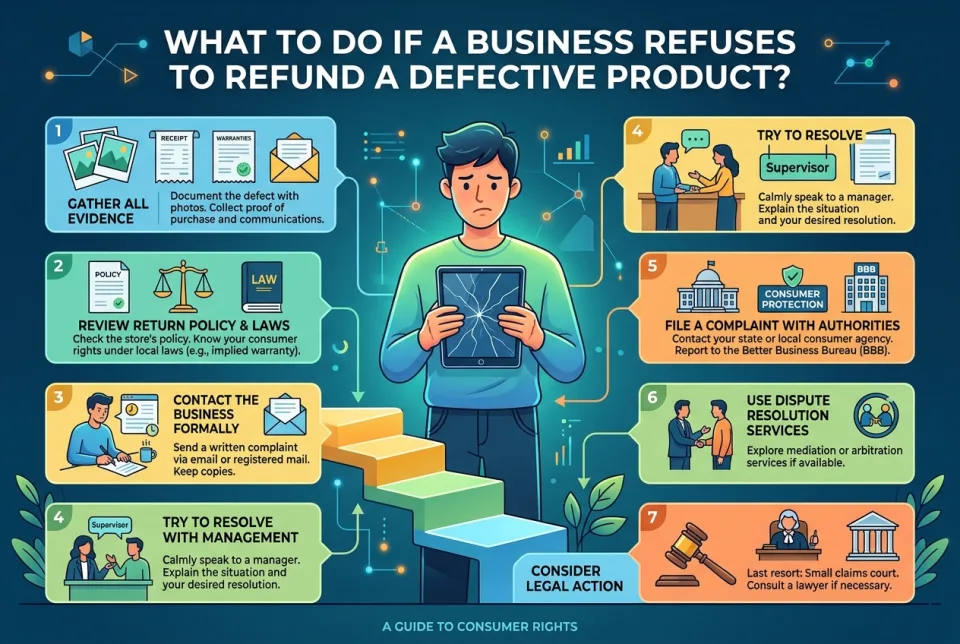
Quick answer
5 steps — read this before anything else
-
1
Check the store's return policy and your rights under consumer protection laws.
-
2
Gather evidence: receipt, photos/videos of the defect, and any communication with the seller.
-
3
Contact the seller in writing (email or letter) requesting a refund, repair, or replacement.
-
4
If refused, file a complaint with your state attorney general or the FTC.
-
5
Consider small claims court or alternative dispute resolution if the amount is significant.
Important — please read
This content is general educational and informational only, and is not a substitute for professional medical advice, diagnosis or treatment. Always seek the advice of a qualified health provider with any questions you may have about a medical condition. Never disregard or delay seeking professional medical care because of something you read here. In an emergency or life-threatening situation, call your local emergency services (police, fire or ambulance) immediately.
When a business refuses to refund a defective product, it can feel frustrating and unfair. However, you have rights. This guide outlines practical steps to resolve the issue, from understanding your legal protections to escalating the matter if necessary.
Understand Your Rights
Consumer protection laws vary by country and state, but many jurisdictions require sellers to refund, repair, or replace defective goods. In the United States, the Federal Trade Commission (FTC) enforces laws against unfair or deceptive practices. Many states have their own consumer protection statutes, often called "lemon laws" for vehicles or general refund laws. Check your state attorney general's website for specifics. Note that return policies can set conditions, but they cannot override your legal rights if a product is defective. A defect means the item does not work as intended or is not of merchantable quality.
Step-by-Step Actions
- Review the return policy. Find the store's written policy (on receipt, website, or posted in-store). It may specify a time limit, condition requirements, or restocking fees. However, if the product is defective, you may still have rights beyond the policy.
- Gather evidence. Collect your receipt, order confirmation, photos or videos of the defect, and any previous communication with the seller. Note dates, names of employees, and what was said.
- Contact the seller calmly and clearly. Speak to a manager or customer service. Explain the defect and ask for a refund, repair, or replacement. Be polite but firm. If in person, ask for the refusal in writing or note the manager's name.
- Put your request in writing. Send an email or letter to the company's customer service or corporate office. State the product, purchase date, defect, and what you want (refund, repair, or replacement). Include copies of evidence. Keep a copy for yourself. This creates a paper trail.
- Escalate within the company. If the first representative refuses, ask to speak to a supervisor or write to the corporate headquarters. Social media complaints can sometimes prompt a response, but keep it factual.
- File a complaint with consumer protection agencies. In the US, you can file a complaint with the FTC (reportfraud.ftc.gov) and your state attorney general's office. These agencies do not resolve individual disputes but can take action against patterns of misconduct. You can also contact the Better Business Bureau (BBB) to file a complaint, though it is not a government agency.
- Consider alternative dispute resolution. Some companies participate in mediation or arbitration. Check your contract or the company's website. Small claims court is an option for amounts within your state's limit (often $5,000 to $10,000). You do not need a lawyer for small claims court.
- Know when to stop. If the amount is small and the effort is disproportionate, you may decide to cut your losses. But for significant purchases, pursuing your rights can be worthwhile.
What NOT to Do
- Do not lose your temper or threaten legal action you cannot follow through on.
- Do not accept a store credit if you are entitled to a refund and want your money back.
- Do not delay. Many consumer protection laws have time limits (statutes of limitations).
- Do not post false or defamatory statements online; stick to facts.
When to Seek Professional Help
If the amount is large or the issue complex, consult a consumer protection lawyer. Many offer free consultations. Legal aid societies can help low-income individuals. If you are in the EU, contact your national consumer center. In the UK, Citizens Advice can help.
This guide is general information and not legal advice. Laws vary, so consult a qualified professional for your specific situation.
Sources & references
Spotted an error? Report it — we correct factual mistakes promptly.
Read next
What Should You Do If a Contractor Takes Your Deposit and Never Starts the Work?
A contractor took your deposit but never started the job. Learn the practical steps to document the problem, demand your money back, and pursue legal options if needed.
What should I do if I receive a defective product?
If you receive a defective product, act quickly: document the issue, contact the seller or manufacturer, and know your rights under consumer protection laws. Here is a step-by-step guide to getting a refund, repair, or replacement.
What can I do if a company refuses to give me a refund?
If a seller refuses a legitimate refund, you have several practical options: document everything, escalate through the company, dispute the charge with your card issuer or payment provider, and report the business to consumer protection agencies.
What should I do if a store refuses to give me a refund?
Stores are not always required to refund you, but they must follow their own posted policy and local consumer law. Here is how to escalate a refund dispute calmly and effectively.
Related handy tools
Checklists, decision guides, scenarios and quizzes for the same situation.