What Should You Do If Your Family Needs Emergency Childcare?
When childcare falls through at the last minute, a calm plan helps you find safe care fast. Here is how to act, who to call, and what to avoid.
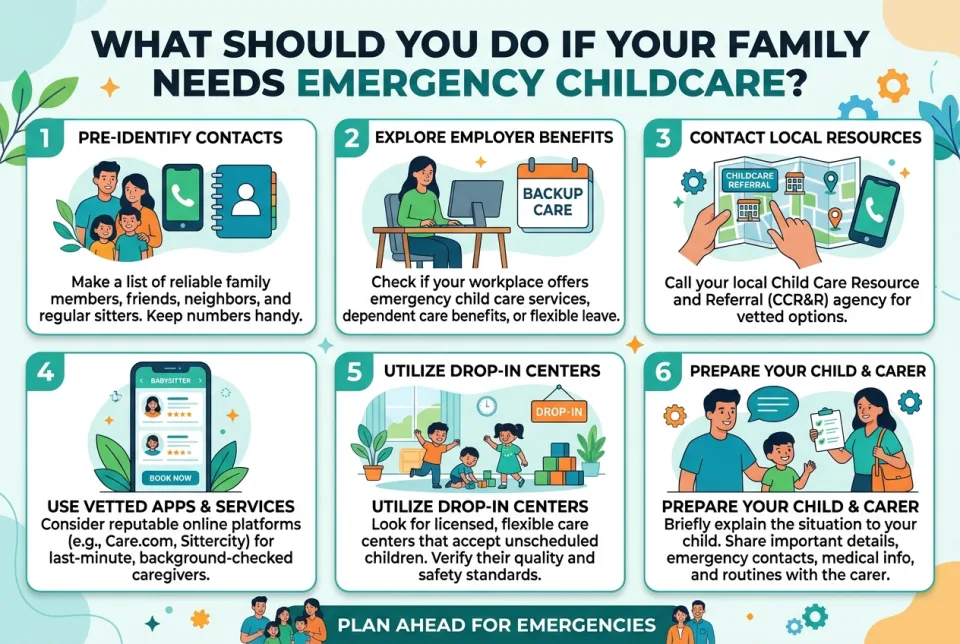
Quick answer
5 steps — read this before anything else
-
1
Stay calm and confirm the gap: how many hours, which children, and what hours you need covered.
-
2
Call your backup list in order: partner or co-parent, nearby family, trusted friends, then licensed drop-in care.
-
3
Ask each person directly for a specific time window, not a vague maybe.
-
4
If no safe option exists, tell your employer you need to use leave or a personal day.
-
5
Never leave children alone or with an unvetted person, even briefly.
Warning
Never leave young children unsupervised or with an unvetted person. If a child is seriously ill, injured, or in immediate danger, call local emergency services immediately.
Childcare can fall apart without warning: a sitter cancels, a daycare closes, a school calls because your child is sick, or you get an urgent work demand. The goal is to find safe, supervised care quickly without putting your child at risk or making a rushed decision you regret.
What is happening
You have a short-term gap between the care you planned and the care you have. This is usually a logistics problem, not an emergency, unless a child is sick, injured, or in immediate danger. Treat it as a time-limited problem with a fixed end point.
Emergency warning
If a child is seriously ill, injured, missing, or in immediate danger, call your local emergency services right now. Emergency childcare is about supervision, not medical care. If you are unsure whether a child needs urgent medical help, call emergency services or a nurse advice line rather than searching for a sitter.
Step by step
- Define the gap precisely. Write down the exact hours you need covered, the children involved, their ages, any allergies or medical needs, and the address where care will happen. Precision makes it easy for someone to say yes.
- Work your backup list in order. Start with a partner or co-parent, then nearby family, then trusted friends or neighbors, then a licensed drop-in or emergency childcare program. Many cities have licensed drop-in centers and some employers offer emergency backup care as a benefit.
- Ask for a specific window. Say: "Can you watch Maya from 8 a.m. to 2 p.m. today at our house?" A concrete request is far easier to answer than "Can you help?"
- Vet anyone new, even fast. Confirm identity, ask for a reference if time allows, and check whether your area has a public childcare licensing lookup. Prefer licensed providers and people you already know.
- Brief the caregiver clearly. Leave written notes: schedule, meals, medications only as prescribed by a clinician, emergency contacts, your phone number, and when you will return.
- Tell your employer early. Ask about backup care benefits, flexible hours, or using paid leave. Early notice is usually better received than a last-minute absence.
- Set a check-in. Agree on a text or call time so you know care is going smoothly.
What NOT to do
- Do not leave children home alone, even for a short errand. Age limits for leaving a child alone vary by place, and young children should never be left unsupervised.
- Do not hand your child to someone you have never met and cannot verify, such as a stranger from an online post with no references.
- Do not ignore your child's illness to make it to work. A sick child may need medical care and should not be placed in group care where they can infect others.
- Do not skip basic safety setup: safe sleep for infants, safe car seats for transport, and no unsafe adults or weapons in the home.
- Do not promise your employer you will be somewhere before you have confirmed care.
When to call for help
Call local emergency services if a child is in danger, seriously hurt, or missing. Contact a doctor or nurse advice line if your child is ill and you are unsure whether they can attend care. If you have no safe option at all, contact local family services or a community helpline; many areas have crisis childcare or family support programs.
How to prevent the next scramble
Build a written backup plan before you need it: two or three vetted sitters, one family member, one licensed drop-in center, and your employer's backup care policy. Keep a go-bag with spare clothes, snacks, and a medication list. Review the plan every few months and update phone numbers.
Start today by writing your backup list and confirming one person who can help on short notice. That single step turns a future crisis into a manageable morning.
This is general information, not professional childcare, legal, or medical advice. In an emergency, call your local emergency services.
Sources & references
Spotted an error? Report it — we correct factual mistakes promptly.
Read next
What Should I Do If I Lack Family Support?
Lacking family support can feel isolating, but you can build a network of care and practical help. This guide offers steps to find emotional and material support.
What Should You Do When You Discover a Family Secret?
Discovering a family secret can be overwhelming. Learn how to process the information, communicate with relatives, and decide what to do next.
What Should I Do When My Family's Expectations Feel Overly High?
When family expectations feel excessive, it can strain your mental health and relationships. Learn practical steps to set boundaries, communicate effectively, and protect your well-being.
What Should I Consider When Comparing an Only Child vs. a Large Family?
There is no single best family size. Research shows that family dynamics, resources, and parenting quality matter far more than the number of siblings.
Related handy tools
Checklists, decision guides, scenarios and quizzes for the same situation.