Tiny unrecognized charges on my card: what to do?
Small unknown charges can be a test by fraudsters or a billing error. Learn how to check, dispute, and protect your account without panicking.
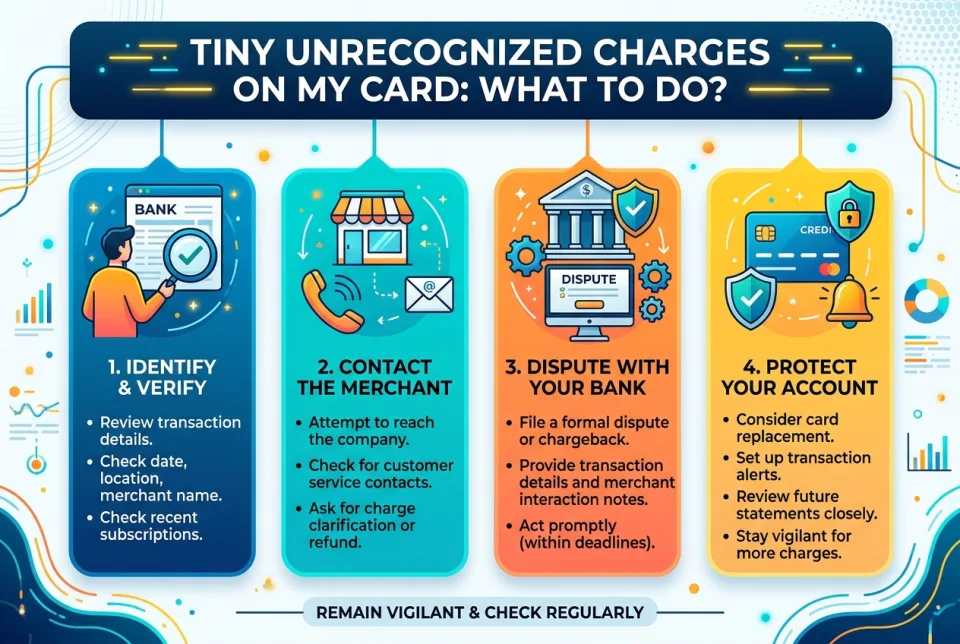
Quick answer
5 steps — read this before anything else
-
1
Log in to your card issuer's app or website and review the charge details (merchant name, date, amount).
-
2
If you do not recognize the merchant, call the number on the back of your card and report it as unauthorized.
-
3
Ask the issuer to block the card and issue a new one if fraud is suspected.
-
4
Monitor your account for further small charges, which may be test transactions.
-
5
Keep a record of the charge and your communication with the issuer.
Warning
If you suspect fraud, act quickly. Small charges may be test transactions before larger fraudulent purchases.
Important — please read
This content is general educational and informational only, and is not a substitute for professional medical advice, diagnosis or treatment. Always seek the advice of a qualified health provider with any questions you may have about a medical condition. Never disregard or delay seeking professional medical care because of something you read here. In an emergency or life-threatening situation, call your local emergency services (police, fire or ambulance) immediately.
Finding a small charge you do not recognize on your card statement can be unsettling. It might be a forgotten subscription, a free trial that converted to paid, or a billing error. It could also be a fraudster testing your card with a tiny amount before attempting larger purchases. The right steps depend on what you discover, but acting quickly is always wise.
What is happening
Small unrecognized charges often fall into one of these categories:
- Free trial conversion: A service you signed up for may have started charging after the trial ended.
- Recurring subscription: You may have forgotten a small monthly or annual fee.
- Billing error: A merchant might have charged the wrong card or amount.
- Card testing fraud: Criminals sometimes make small charges to see if a stolen card is active before making larger fraudulent purchases.
Because the amount is small, many people ignore it, but that can be a mistake if fraud is involved.
Step by step: what to do first
- Check the charge details. Open your card issuer's app or online banking and look at the transaction. Note the merchant name, date, amount, and any reference number. Sometimes the merchant name is abbreviated or unfamiliar.
- Search your email and records. Look for receipts or subscription confirmations that match the charge. Check your app store subscriptions (Apple, Google) and any free trials you may have started.
- Contact the merchant if you can identify them. Ask for an explanation and a refund if it is a mistake or an unwanted subscription. Many companies will cancel and refund without hassle.
- If you cannot identify the merchant or suspect fraud, call your card issuer immediately. Use the phone number on the back of your card or in the issuer's app. Report the charge as unauthorized. The issuer may block your card and send a new one.
- Follow up in writing. If the issuer asks you to submit a dispute form, do so promptly and keep a copy. Note the date, time, and reference number of your call.
What NOT to do
- Do not ignore it. Small charges can be a precursor to larger fraud.
- Do not click links in unexpected emails or texts about the charge. Scammers often send fake alerts to steal your login details. Go directly to your issuer's app or website.
- Do not share your card number, PIN, or one-time codes with anyone who contacts you. Your issuer will never ask for these.
- Do not dispute a charge before checking if it is a legitimate subscription you forgot about. False disputes can lead to account restrictions.
When to seek professional help
If you suspect identity theft, if multiple unauthorized charges appear, or if the issuer does not resolve your dispute, you may need to escalate. In the US, you can file a complaint with the Consumer Financial Protection Bureau (CFPB). In other countries, contact your local financial regulator or consumer protection agency. For legal advice, consult a qualified attorney.
How to prevent future issues
- Review your statements regularly, at least monthly.
- Use virtual card numbers for online subscriptions when your issuer offers them.
- Set up transaction alerts for any charge above a small amount.
- Keep a list of active subscriptions and their renewal dates.
- Enable two-factor authentication on your card issuer account.
Taking these steps promptly will help you resolve the charge and protect your finances.
Sources & references
Spotted an error? Report it — we correct factual mistakes promptly.
Read next
Bank card blocked unexpectedly: what to do?
A blocked card can be frustrating, but it is usually a security measure. Learn the safe steps to unblock it and protect your money.
Duplicate subscription charges on my statement: what to do?
If you see the same subscription charge twice, act quickly to stop further charges and request a refund. Here is a step-by-step guide to resolve duplicate subscription charges.
Paypal or online payment unauthorized: what to do?
An unauthorized payment can be alarming, but acting quickly can limit the damage. Here is a step-by-step guide to securing your accounts and disputing the charge.
Scam investment offer: what to do?
Learn how to recognize and respond to a scam investment offer, protect your money, and report the fraud to the right authorities.
Related handy tools
Checklists, decision guides, scenarios and quizzes for the same situation.