What Should You Do If You Suspect Your Paycheck Contains Wage Errors?
A paycheck error can be a simple mistake or a sign of a bigger problem. Here is how to document the issue, approach your employer, and escalate if needed.
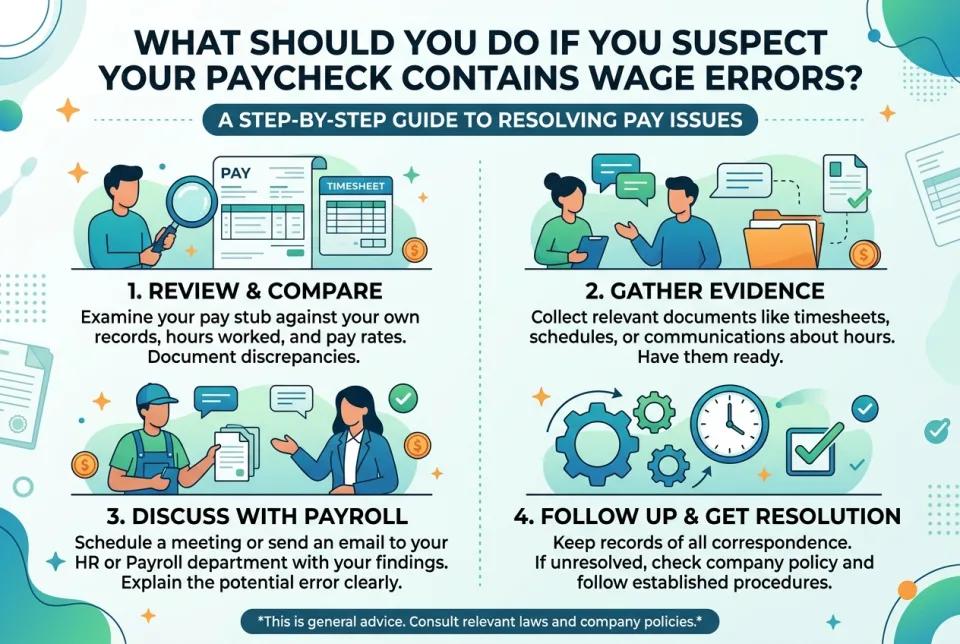
Quick answer
5 steps — read this before anything else
-
1
Compare your pay stub to your timesheet, offer letter, and pay rate before doing anything else.
-
2
Write down the exact discrepancy: hours, rate, overtime, deductions, or missing pay.
-
3
Report the error to payroll or HR in writing and keep a copy.
-
4
Track your state's deadline for wage claims; some are as short as one year.
-
5
If your employer does not fix it, file a wage complaint with your state labor office or the U.S. Department of Labor.
Important — please read
This content is general educational and informational only, and is not a substitute for professional medical advice, diagnosis or treatment. Always seek the advice of a qualified health provider with any questions you may have about a medical condition. Never disregard or delay seeking professional medical care because of something you read here. In an emergency or life-threatening situation, call your local emergency services (police, fire or ambulance) immediately.
Finding an error on your paycheck is stressful, but it is usually fixable. Payroll mistakes happen for many reasons: a missed timesheet entry, a wrong hourly rate, an incorrect tax withholding, or a misclassified overtime hour. The key is to act quickly, keep written records, and know your options if your employer does not correct the problem.
What Counts as a Wage Error
Common paycheck problems include: missing hours you worked, paying a lower rate than agreed, failing to pay overtime when required, unauthorized deductions, missing tips or commissions, or incorrect tax withholding. Under the federal Fair Labor Standards Act (FLSA), most hourly employees must be paid at least the federal minimum wage and 1.5 times their regular rate for hours over 40 in a workweek, unless an exemption applies. Your state may have stronger rules.
Step 1: Gather Your Records
Before contacting anyone, collect evidence. Pull your pay stub, your timesheet or time-tracking app records, your offer letter or employment contract, and any emails about your rate or schedule. Write a short summary of the discrepancy: the pay period, the hours or amount you expected, the amount you received, and the difference. Keep this factual and specific.
Step 2: Contact Payroll or HR in Writing
Send an email or written message to your payroll department or HR. State the issue plainly: "My paycheck for the period ending [date] appears to be short by [X hours or amount]. I have attached my timesheet and pay stub." Ask for a correction and a timeline. Keep a copy of every message. A polite, documented approach resolves most honest errors within one or two pay cycles.
Step 3: Escalate Internally
If payroll does not respond or refuses to fix a legitimate error, escalate to a manager, a higher HR contact, or the company's finance department. Put your request in writing each time. Note the dates of your conversations and what was promised.
Step 4: File a Wage Complaint
If internal steps fail, you can file a complaint with your state labor department or the U.S. Department of Labor's Wage and Hour Division. These agencies investigate claims of unpaid wages, overtime violations, and illegal deductions. Filing is generally free. Be aware that there are deadlines: under the FLSA, claims for unpaid minimum wage or overtime generally must be filed within two years, or three years for willful violations, and many states have shorter limits. Do not wait.
What NOT to Do
- Do not quit or walk off the job before you have documented the issue and explored your options.
- Do not accept a verbal promise of a fix without written confirmation.
- Do not alter timesheets or pay records, even to "correct" them yourself.
- Do not delay: wage claim deadlines can expire while you wait.
- Do not assume a deduction is legal just because it appears on your stub; some deductions require your written consent or are prohibited.
When to Get Professional Help
If the amount is significant, if your employer retaliates against you for raising the issue, or if you believe you are being misclassified as an independent contractor, consider consulting an employment attorney. Many offer free initial consultations, and some work on a contingency basis for wage cases. Retaliation for asserting your wage rights is generally illegal under the FLSA and many state laws.
Prevent Future Errors
Review every pay stub as soon as you receive it. Track your hours independently. Confirm your pay rate, overtime eligibility, and deduction authorizations in writing when you are hired or when your role changes. Small habits prevent bigger problems later.
Start today by comparing your most recent pay stub to your own records. If something does not add up, put your concern in writing and send it to payroll. A clear, documented request is the fastest path to a correction.
Sources & references
Spotted an error? Report it — we correct factual mistakes promptly.
Read next
What Should You Do If You Feel Burned Out by Your Workload?
Feeling burned out by your workload is common, but it is not something you have to accept. Learn 10 practical ways to set better boundaries and protect your energy.
What Should I Do If There Are No Advancement Opportunities at Work?
Feeling stuck in your career can be frustrating and demotivating. Learn practical steps to assess your situation, create growth opportunities, and decide when it's time to move on.
What Should I Do After a Failed Job Interview?
A failed job interview feels awful, but it is not the end of your career. Learn how to process the rejection, extract useful feedback, and turn the experience into a stronger next application.
What to Do If Your CV Gets Rejected
Having your CV or resume rejected can be discouraging, but it provides an opportunity to optimize your strategy. Learn how to analyze feedback and refine your job applications.
Related handy tools
Checklists, decision guides, scenarios and quizzes for the same situation.