What Should You Do If Your Personal Information Is Exposed in a Data Breach?
A data breach can expose your passwords, financial details, or identity. Taking fast, specific steps limits the damage and protects your accounts.
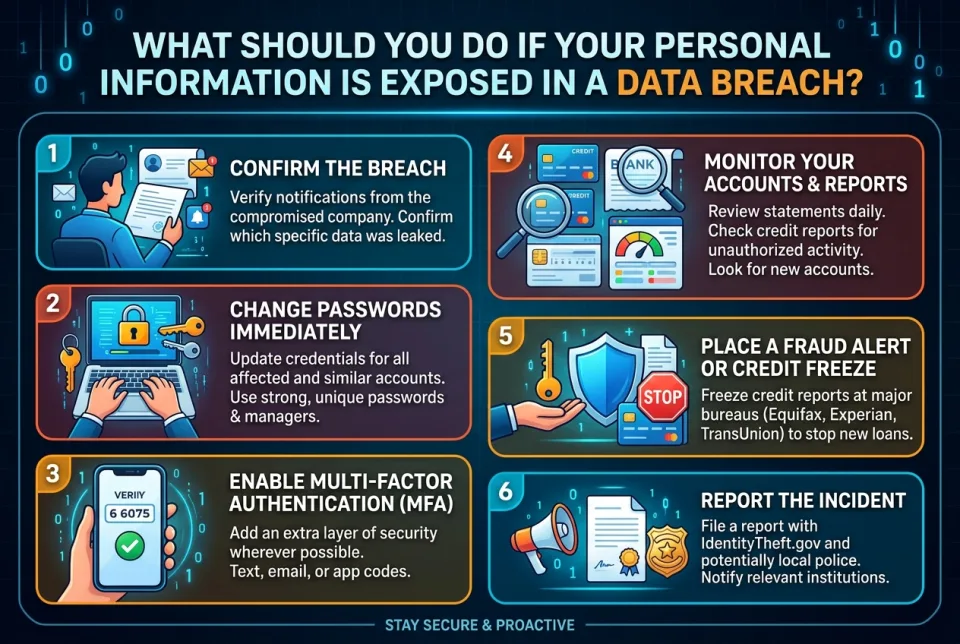
Quick answer
5 steps — read this before anything else
-
1
Change the password for the breached account and any account that reuses it.
-
2
Turn on two-factor authentication everywhere it is offered.
-
3
Check your bank and credit card statements for unfamiliar charges.
-
4
Place a free fraud alert or freeze your credit with the major credit bureaus.
-
5
Watch for phishing emails, texts, or calls that reference the breach.
Warning
If money is missing from an account or someone has opened credit in your name, contact your bank and the relevant fraud authority immediately.
A data breach happens when an unauthorized person accesses a system and steals personal information such as passwords, email addresses, payment card numbers, or government ID numbers. You usually cannot undo the breach, but the actions you take in the first hours and days strongly affect how much harm results.
What to do first
- Find out what was exposed. Read the breach notice from the company or check a reputable breach-notification service. The type of data matters: a leaked password is urgent, a leaked email address alone is lower risk.
- Change the breached password immediately. If you reused that password on other sites, change it there too. Reused passwords are the single biggest reason one breach leads to many compromised accounts.
- Turn on two-factor authentication (2FA). Enable it on email, banking, social media, and any account that holds payment details. Prefer an authenticator app or hardware key over SMS codes.
- Check your financial accounts. Review recent transactions on cards and bank accounts. Report anything you do not recognize to your bank or card issuer right away.
- Freeze or lock your credit. In the United States, you can place a free security freeze with Equifax, Experian, and TransUnion. A freeze blocks most lenders from viewing your credit file, which makes opening new accounts in your name much harder. A fraud alert is a lighter, also free option.
What NOT to do
- Do not click links in an email or text claiming to be from the breached company. Go to the official website yourself and log in.
- Do not pay anyone who calls demanding money to "fix" your credit or remove your data.
- Do not ignore the breach because nothing looks wrong yet. Identity theft can surface months later.
- Do not reuse the new password on other sites.
Watch for follow-up attacks
After a breach, criminals often send convincing phishing messages that mention the real company and the real breach. Never share passwords, one-time codes, or card numbers in response to an unexpected message. If someone claims to be your bank, hang up and call the number on your card.
When to seek professional help
Contact your bank immediately if money is missing. If someone has opened accounts or filed taxes in your name, report it to the relevant authority in your country, such as the Federal Trade Commission in the United States, and file a police report if local rules require one. Consider an identity-theft recovery service only if you are overwhelmed, and verify any provider is legitimate.
How to reduce future risk
Use a password manager to create unique passwords for every account. Keep your devices and apps updated. Review your credit reports at least once a year. Consider a credit freeze if you are not applying for new credit soon.
Act on the first two steps today: change the exposed password and enable 2FA on your most important accounts. Those two actions stop the majority of follow-on damage.
This is general information, not legal or financial advice. Rules and available protections vary by country, so check your local consumer protection agency for specifics.
Sources & references
Spotted an error? Report it — we correct factual mistakes promptly.
Read next
What Should You Do If a Contractor Takes Your Deposit and Never Starts the Work?
A contractor took your deposit but never started the job. Learn the practical steps to document the problem, demand your money back, and pursue legal options if needed.
What Should You Do If Someone Uses Your Identity to Open a Phone Account?
Identity thieves can open phone accounts in your name, leaving you with fraudulent bills and potential legal issues. Here is a step-by-step guide to report, dispute, and recover.
What Should You Do If You Receive a Surprise Medical Bill?
A surprise medical bill can be confusing and stressful. Learn how to verify the charges, understand your rights under the No Surprises Act, and take action to dispute or reduce the bill.
What Should You Do If You Lose Your Student ID or Important Documents?
Losing your student ID or important documents can be stressful, but acting quickly can prevent misuse and help you get replacements. Here's a step-by-step guide to secure your identity and replace what's lost.
Related handy tools
Checklists, decision guides, scenarios and quizzes for the same situation.