What Should You Do If You See a Dog Left in a Hot Car?
A dog locked in a hot car can suffer heatstroke or die within minutes. Learn how to assess the situation, get help, and act safely without putting yourself or the animal at risk.
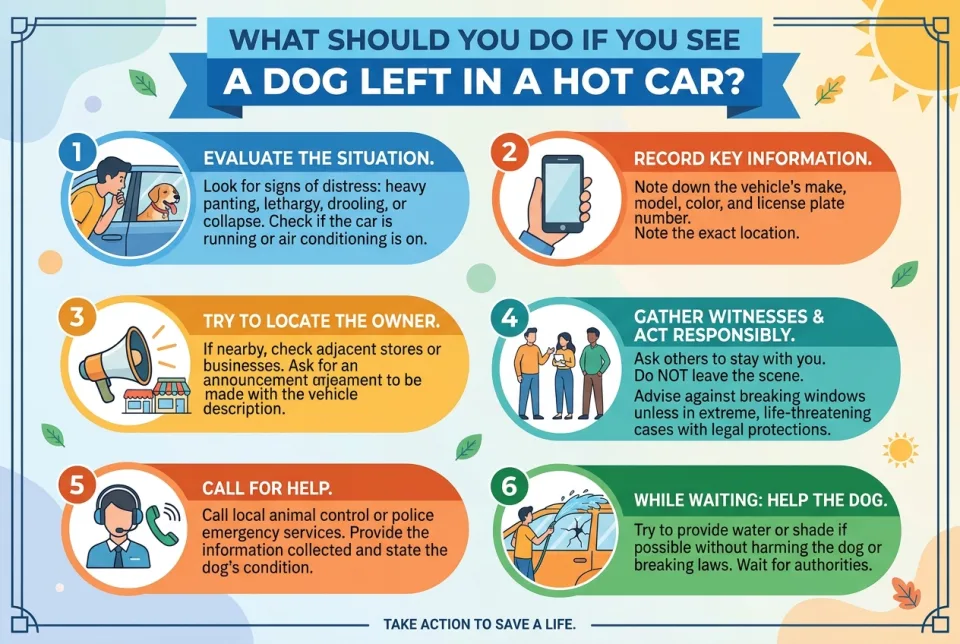
Quick answer
5 steps — read this before anything else
-
1
Note the car's location, color, and license plate, and check whether the dog is in distress (heavy panting, drooling, weakness, collapse).
-
2
Call local emergency services or animal control immediately; give them the exact location and the dog's condition.
-
3
Stay with the vehicle and try to get the owner paged or located through nearby businesses.
-
4
If the dog is in imminent danger and officials cannot arrive in time, follow local laws before attempting any rescue.
-
5
Once the dog is out, move it to shade or air conditioning and offer small amounts of cool water while waiting for a vet.
Warning
A dog in a hot car can die within minutes. Call local emergency services or animal control immediately. Do not break a window unless the dog is in immediate danger and you have confirmed what local law allows.
Important — please read
This content is general educational and informational only, and is not a substitute for professional medical advice, diagnosis or treatment. Always seek the advice of a qualified health provider with any questions you may have about a medical condition. Never disregard or delay seeking professional medical care because of something you read here. In an emergency or life-threatening situation, call your local emergency services (police, fire or ambulance) immediately.
A parked car can heat up far faster than most people expect, and a dog left inside can reach a dangerous body temperature in just a few minutes. Even on a mild day, the inside of a car can become much hotter than the outside air. If you see a dog alone in a hot vehicle, quick and calm action can save its life.
What is happening
Dogs cannot cool themselves efficiently. They rely mostly on panting, and in a hot, enclosed space that is not enough. Temperatures inside a parked car can rise rapidly, and cracking a window does little to slow it down. Heatstroke in dogs is a medical emergency that can cause organ damage or death.
Emergency warning
If a dog appears to be in distress, call your local emergency services or animal control right away. Do not wait to see if the owner returns.
What to do first
- Assess the dog. Signs of distress include heavy panting, thick drooling, wide eyes, wobbling, vomiting, or collapse. A dog that is unresponsive or limp needs help immediately.
- Call for help. Contact local emergency services or animal control. Give the exact location, the car's make, model, color, and license plate, and describe the dog's condition.
- Try to find the owner. Ask nearby businesses or staff to page the owner over a public address system. Note how long the dog has been alone.
- Stay with the car. Keep watching the dog and update the dispatcher if its condition changes.
What NOT to do
- Do not break a window unless the dog is in immediate danger and you have confirmed what your local laws allow. In many places there are specific conditions and protections, and in others you could face legal consequences.
- Do not put yourself in danger by reaching into a car with an unknown, frightened, or aggressive dog.
- Do not give the dog large amounts of ice-cold water or ice. Rapid cooling can cause other problems. Offer small sips of cool water only if the dog is alert.
- Do not leave the scene assuming someone else will handle it.
If you must act
If the dog is collapsing or clearly dying and help is not arriving, call the dispatcher back and ask what to do. Follow their instructions and any local law that permits a rescue. If you do get the dog out, move it to shade or an air-conditioned space, keep it calm, and get it to a veterinarian immediately. Heatstroke can worsen even after the dog is out of the heat.
When to seek professional care
Any dog that has been in a hot car should be checked by a veterinarian, even if it seems to recover. Call ahead so the clinic can prepare for an emergency. Tell them how long the dog was in the car and what signs you saw.
What to monitor
Watch for continued heavy panting, weakness, vomiting, diarrhea, stumbling, tremors, or a change in gum color. These can signal serious heat injury. Do not assume the dog is fine just because it is drinking.
How to prevent it
Never leave a dog in a parked car, even briefly and even with the windows down. If you are traveling, ask someone to stay with the dog or leave it at home. If you see a dog in a hot car, act quickly and call for help rather than waiting.
This is general information and not a substitute for professional veterinary advice. In an emergency, call your local emergency services or a veterinarian immediately.
Sources & references
Spotted an error? Report it — we correct factual mistakes promptly.
Read next
What Should You Do If Your Dog Is Sprayed by a Skunk?
Skunk spray is oily and stubborn, but a simple homemade rinse works far better than plain water. Here is how to safely de-skunk your dog without irritating its skin or eyes.
What Should I Do If an Adoption Is Not Going as Planned?
Adoption delays, changes of heart, or unexpected legal hurdles are common and rarely mean the process is over. Here is how to stabilise the situation, protect your rights, and decide your next step.
Rabbit stopped eating hay: why it is urgent
A rabbit that stops eating hay is at risk of a dangerous slowdown in gut movement. Learn the warning signs and act fast.
Dog barks constantly when left alone: what to do?
Constant barking when left alone often signals distress or boredom. Learn how to assess the cause, reduce barking, and when to seek professional help.
Related handy tools
Checklists, decision guides, scenarios and quizzes for the same situation.