What Should You Do If Your Teenager Shares Personal Information With a Stranger Online?
If your teenager has shared personal details with a stranger online, stay calm, gather facts, and take practical steps to secure their accounts and privacy while keeping communication open.
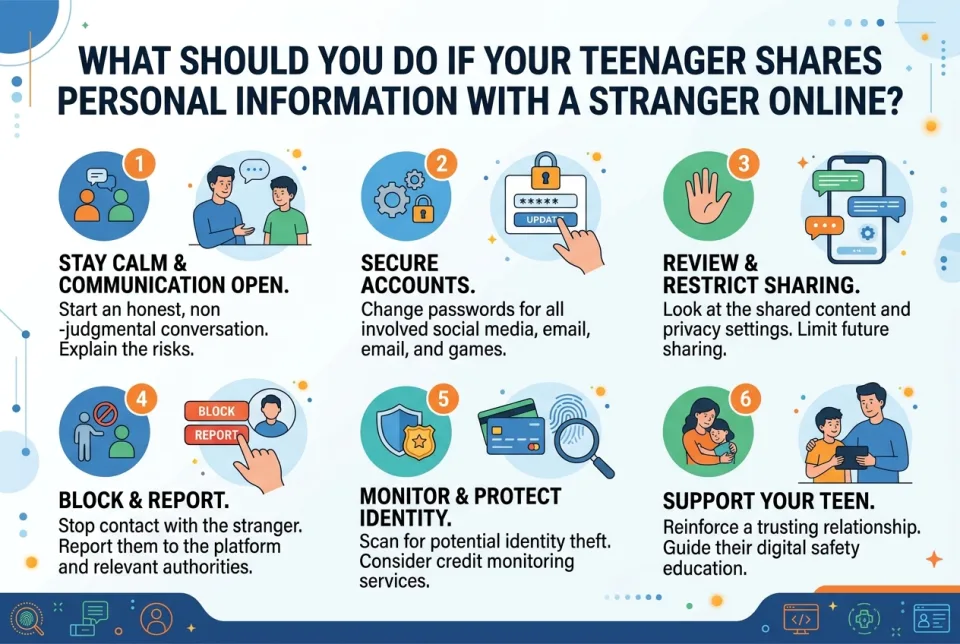
Quick answer
5 steps — read this before anything else
-
1
Stay calm and avoid blaming or punishing your teen for telling you.
-
2
Ask what information was shared, where, and with whom, without interrogating.
-
3
Secure accounts by changing passwords and enabling two-factor authentication.
-
4
Report and block the stranger on the platform and preserve evidence.
-
5
Contact local law enforcement if there are threats, sextortion, or requests to meet.
Warning
If the stranger has threatened your teen, asked for sexual images, attempted sextortion, or suggested meeting in person, contact local law enforcement immediately. In the US, you can also report to the NCMEC CyberTipline.
Discovering that your teenager has shared personal information with a stranger online can feel alarming. The most important first step is to stay calm and keep the conversation open. If your teen feels judged or punished for telling you, they may hide future incidents, which makes them less safe.
What is happening
Online strangers may ask for a teen's full name, school, address, phone number, photos, passwords, or location. Sometimes this starts as a friendly chat, a game partnership, or a fake profile. The risk ranges from unwanted contact and scams to grooming, sextortion, or attempts to arrange an in-person meeting.
What to do first
- Stay calm and listen. Thank your teen for telling you. Ask open questions: What information was shared? On which app or game? What did the person say or ask for? Do not delete anything yet.
- Preserve evidence. Take screenshots of the profile, messages, usernames, and any requests. This helps if you need to report the account or contact law enforcement.
- Block and report the stranger. Use the platform's block and report tools. Reporting helps the platform remove the account and may protect other users.
- Secure accounts. Change passwords on the teen's email, social media, gaming, and messaging accounts. Use unique passwords and turn on two-factor authentication. Check for unknown logged-in devices and remove them.
- Limit further exposure. Review privacy settings, remove personal details from public profiles, and turn off location sharing. If a phone number or address was shared, consider whether a temporary change or added vigilance is needed.
- Assess the risk level. If the stranger threatened, blackmailed, asked for sexual images, or suggested meeting in person, treat it as a serious safety issue and contact local law enforcement. In the US, reports can also be made to the National Center for Missing & Exploited Children (NCMEC) through their CyberTipline.
What NOT to do
- Do not shame, blame, or take away all devices as a first response. This can push your teen to hide future contact.
- Do not confront the stranger yourself or agree to any meeting.
- Do not delete messages or accounts before saving evidence.
- Do not assume it is harmless just because no meeting has happened yet.
- Do not share the stranger's messages publicly in a way that could expose your teen to more harassment.
When to call for help
Contact local law enforcement immediately if there are threats, sexual requests, sextortion, or any attempt to meet in person. If your teen is in immediate danger, call emergency services. For ongoing support, a school counselor or a licensed mental health professional can help your teen process the experience.
What to monitor
Watch for changes in mood, sleep, school performance, or sudden secrecy with devices. Keep an eye on new accounts, unknown contacts, and requests for money or gift cards. Reassure your teen that they are not in trouble and that you are working through this together.
How to prevent it
Set clear family rules about what personal information is never shared online, including full name, school, address, phone number, and location. Review privacy settings together. Teach your teen to recognize grooming tactics such as flattery, secrecy, and requests to move to a private app. Keep devices in shared spaces when possible, and check in regularly without spying.
Your next action: preserve the evidence, secure the accounts, and decide together whether a report to the platform or law enforcement is needed. This is general information and not a substitute for professional advice. In an emergency, contact local emergency services.
Sources & references
Spotted an error? Report it — we correct factual mistakes promptly.
Read next
What Should You Do If Your Child Is Refused Entry to School Because of Missing Documents?
If your child is turned away from school because of missing paperwork, stay calm and act quickly. This guide explains how to resolve the issue and get your child enrolled.
What Should I Do If I Have a Difficult Relationship With My Step-Parent?
Step-family relationships can be complicated. This guide offers practical steps to reduce conflict, protect your wellbeing, and decide when to seek outside help.
What Should I Consider When Comparing an Only Child vs. a Large Family?
There is no single best family size. Research shows that family dynamics, resources, and parenting quality matter far more than the number of siblings.
What to Do to Prepare for Back to School
Get ready for a smooth school year with a plan for routines, supplies, health checks, and emotional readiness. These practical steps help students and parents start strong.
Related handy tools
Checklists, decision guides, scenarios and quizzes for the same situation.