What Should You Do If a Wild Animal Enters Your Campsite?
Stay calm, keep your distance, and never feed or corner a wild animal. Learn how to react safely to bears, raccoons, snakes, and other wildlife in camp.
Quick answer
5 steps — read this before anything else
-
1
Stay calm and do not run or scream.
-
2
Give the animal a clear escape route and back away slowly.
-
3
Make yourself look large and speak in a firm, low voice.
-
4
If it approaches or acts aggressively, use bear spray or throw objects and call emergency services.
-
5
Never feed, corner, or try to pet any wild animal.
Warning
Never run from a bear, cougar, or wolf, and never feed or corner any wild animal. If a large predator acts aggressively or anyone is bitten, call emergency services or a ranger immediately.
Wild animals enter campsites because they smell food, are curious, or are passing through. Most encounters end quickly if you stay calm and give the animal room to leave. The right response depends on the species, so learn the basics before you go.
What is happening
Animals are drawn to campsites by food, garbage, scented toiletries, and cooking smells. A startled or cornered animal is far more dangerous than one that is simply passing by. Your goal is to avoid a surprise and to let the animal retreat.
Emergency warning
If a large predator such as a bear, cougar, or wolf is acting aggressively, do not run. Call local emergency services or the park ranger immediately once you are safe. For any bite, scratch, or spray exposure, seek urgent medical care, because rabies and infection are serious risks.
What to do first
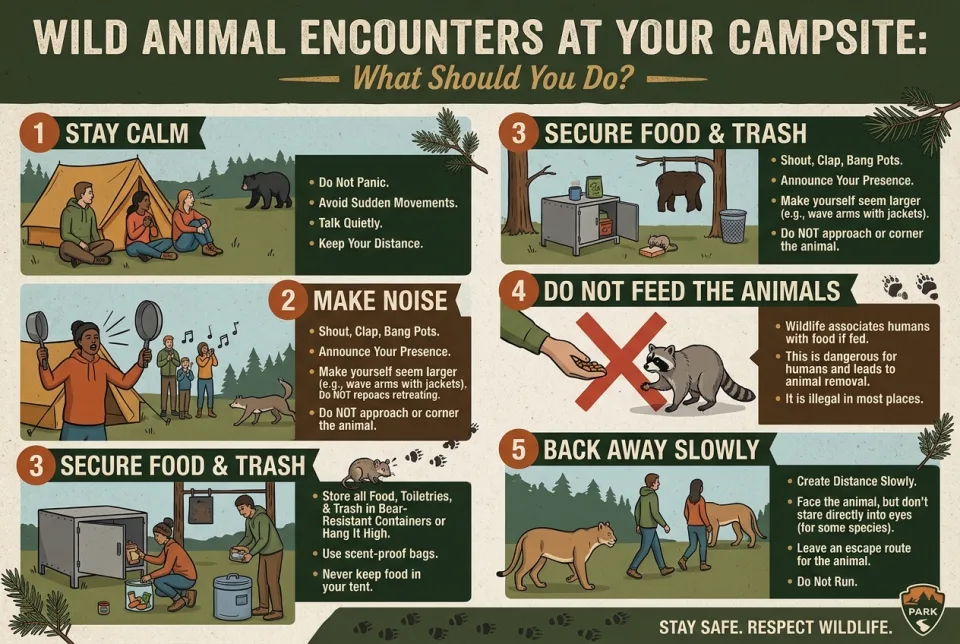
- Freeze and assess. Stop moving, look at the animal, and note its size and behavior.
- Do not run. Running triggers a chase response in predators and can make a bluff charge real.
- Back away slowly. Keep facing the animal, speak in a calm, firm voice, and give it an open escape route.
- Make yourself look large. Raise your arms, open your jacket, and stand tall. For bears, group together if you are with others.
- Use deterrents if it approaches. Bear spray is effective on bears and other large mammals when used at close range. Throw rocks or sticks only if the animal keeps advancing.
- Get inside a hard-sided vehicle or building if one is nearby and you can reach it without turning your back.
What NOT to do
- Never feed a wild animal or leave food out to distract it.
- Never corner, chase, or try to pet any animal, even a small one.
- Never run from a bear, cougar, or wolf.
- Never get between a mother and her young.
- Never try to handle a snake or unknown animal, even if it looks dead.
- Never play dead unless a bear has made physical contact and you are certain it is a defensive attack.
Species-specific tips
Bears
Speak calmly, back away, and avoid direct eye contact. If a bear charges, stand your ground and use bear spray. If it makes contact, play dead by lying face down, protecting your neck, and staying still until it leaves.
Cougars and wolves
Do not run. Face the animal, make yourself large, and fight back if attacked. Throw objects and shout.
Raccoons, skunks, and rodents
These animals usually flee if you make noise and stand your ground. Never corner them, as they can bite or spray.
Snakes
Stop and back away slowly. Most bites happen when people try to move or kill a snake. If bitten, keep the limb still and seek emergency care.
When to seek professional care
Call emergency services or a ranger for any aggressive large animal, any bite or scratch, or if the animal will not leave. For bites, wash the wound with soap and water and get medical care the same day, because rabies prevention may be needed.
How to prevent it
- Store food, garbage, and scented items in sealed containers or a vehicle, never in your tent.
- Cook and eat at least 100 feet from where you sleep.
- Never leave food unattended, and clean up all scraps.
- Keep pets leashed and never leave them alone.
- Check local wildlife warnings before you camp.
Most encounters end safely when you stay calm and give the animal space. If an animal is aggressive or you are injured, call emergency services or a ranger right away.
This is general information, not a substitute for professional medical advice. In an emergency, call your local emergency services.
Sources & references
Spotted an error? Report it — we correct factual mistakes promptly.
Frequently asked questions
Read next
What should you do if your tent leaks during a rainstorm?
Stay dry and safe when your tent leaks in a storm: protect your sleeping bag, find the leak, and make temporary repairs without making things worse.
What should you do if you get caught in a rip current while swimming?
Rip currents are powerful, narrow channels of fast-moving water that can pull even strong swimmers away from shore. Knowing how to respond calmly and correctly can save your life.
What Should You Do If You Get a Blister While Backpacking?
Blisters are the most common backpacking injury. Acting early, before the blister fully forms, can keep you walking. Here is how to treat one safely on the trail.
Related handy tools
Checklists, decision guides, scenarios and quizzes for the same situation.