What Should You Do If You Cannot Afford a Senior Living Community?
Senior living costs can exceed $50,000 per year, but there are real alternatives. Learn how to find affordable housing, in-home care, and financial assistance programs.
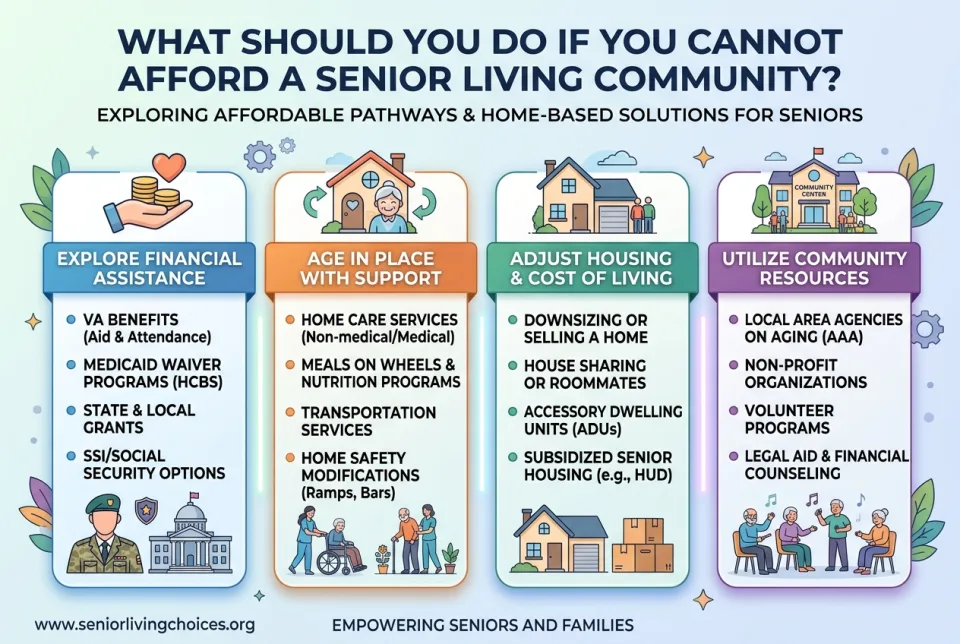
Quick answer
5 steps — read this before anything else
-
1
Contact your local Area Agency on Aging (call 211 or eldercare.acl.gov) to learn about subsidized housing and Medicaid waivers.
-
2
Ask about Medicaid HCBS waivers, which can pay for in-home care or assisted living for those who qualify.
-
3
Check if you qualify for Section 202 Supportive Housing for the Elderly or Low-Income Housing Tax Credit (LIHTC) apartments.
-
4
Consider aging in place with in-home support, which is often cheaper than a private senior community.
-
5
Consult a HUD-approved housing counselor or elder law attorney for state-specific programs.
Important — please read
This content is general educational and informational only, and is not a substitute for professional medical advice, diagnosis or treatment. Always seek the advice of a qualified health provider with any questions you may have about a medical condition. Never disregard or delay seeking professional medical care because of something you read here. In an emergency or life-threatening situation, call your local emergency services (police, fire or ambulance) immediately.
Senior living communities can cost from $3,000 to over $8,000 per month, depending on the level of care and location. If your savings, pension, or Social Security cannot cover that, you are not alone, and you do have options. The key is to act early and explore every program for which you might qualify.
What is happening
Most senior living is paid for privately. Medicare does not cover long-term residential care, and Medicaid only pays for skilled nursing facilities after a spend-down. However, a patchwork of federal, state, and local programs can help with housing, in-home care, and assisted living costs for people with limited income and assets.
What to do first
- Contact your local Area Agency on Aging (AAA). Call 211 or use the Eldercare Locator at eldercare.acl.gov. They can screen you for benefits and connect you to subsidized housing and care programs in your area.
- Ask about Medicaid Home and Community-Based Services (HCBS) waivers. These waivers can pay for in-home care, adult day care, or assisted living for people who need a nursing-home level of care but want to live at home or in a community setting. Waitlists can be long, so apply as soon as possible.
- Apply for subsidized senior housing. HUD's Section 202 program provides apartments for very low-income elderly people. Low-Income Housing Tax Credit (LIHTC) properties also offer reduced rents. Contact your local public housing authority for applications.
- Explore in-home care alternatives. Aging in place with a part-time aide, family help, or volunteer programs is often far less expensive than a private community. Medicaid, veterans' benefits, and some state programs can cover these services.
- Check veterans' benefits. If you or your spouse served in the military, the VA may provide a pension with Aid and Attendance, which can help pay for assisted living or in-home care.
What NOT to do
- Do not assume you must sell your home or spend all your savings before getting help. Many programs have different rules, and some protect a portion of assets.
- Do not sign a private-pay contract you cannot afford without first asking about Medicaid bed availability and spend-down rules.
- Do not ignore waitlists. Get on them early, even if you are not ready to move.
- Do not pay for expensive placement services before checking free options through your AAA or eldercare locator.
When to seek professional help
Speak with a HUD-approved housing counselor (800-569-4287) for free advice on housing and rental assistance. An elder law attorney can explain Medicaid rules in your state, including income and asset limits, and help you plan legally. Your local AAA can also provide free benefits counseling.
What to monitor
Keep track of application deadlines, waitlist status, and annual open enrollment periods for Medicare and Medicaid. Review your budget monthly and document all applications and correspondence. If your health changes, reassess whether you now qualify for a higher level of care or a different waiver.
How to prevent a crisis
Plan ahead before your savings run out. Talk with family about shared housing, explore home modifications that let you stay independent, and build a small emergency fund if possible. The earlier you start, the more options you will have.
Start today by calling 211 or visiting eldercare.acl.gov to find your local Area Agency on Aging. They can tell you exactly which programs you may qualify for and how to apply. This is general financial information, not legal or medical advice; consult a qualified professional about your specific situation.
Sources & references
Spotted an error? Report it — we correct factual mistakes promptly.
Read next
What should you do if you are considering a reverse mortgage?
A reverse mortgage can provide cash in retirement but comes with complex rules and long-term costs. Learn the essential steps to evaluate whether it fits your situation.
What should I do if I need to set up a power of attorney for an aging relative?
Setting up a power of attorney for an aging relative requires careful planning, legal advice, and clear communication. This guide outlines the key steps and considerations.
What should you do if you need to downsize and sell the family home?
Downsizing and selling the family home is a major financial and emotional decision. This guide walks you through the practical steps to plan, prepare, and sell with confidence.
What should you do if you feel lonely or isolated after retirement?
Retirement can bring a sudden loss of daily social contact. Rebuilding connection takes small, deliberate steps, and persistent loneliness is worth discussing with a doctor.
Related handy tools
Checklists, decision guides, scenarios and quizzes for the same situation.