What Should You Do If Your Retirement Savings Are Not Enough to Cover Your Expenses?
If your retirement savings fall short of your expenses, take a calm, step-by-step approach to reduce costs, increase income, and protect your long-term stability.
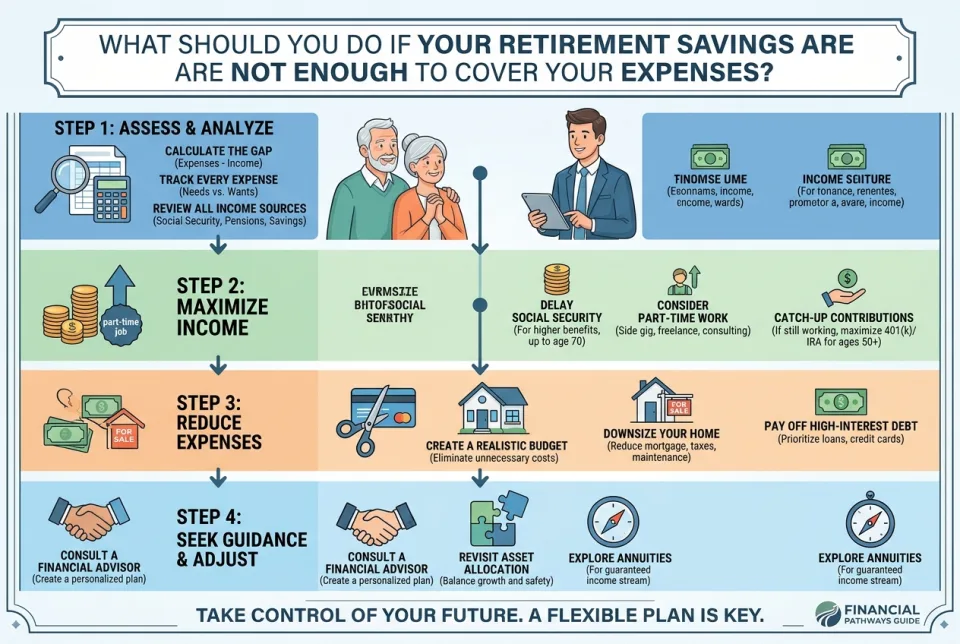
Quick answer
5 steps — read this before anything else
-
1
Calculate your exact monthly shortfall by subtracting guaranteed income from essential expenses.
-
2
Cut non-essential spending and review recurring bills for immediate savings.
-
3
Explore safe income options like part-time work, delaying Social Security, or a reverse mortgage if you are 62 or older.
-
4
Consult a fee-only fiduciary financial advisor or a free HUD-approved housing counselor for personalized guidance.
-
5
Avoid high-risk investments, payday loans, and unsolicited offers that promise quick fixes.
Important — please read
This content is general educational and informational only, and is not a substitute for professional medical advice, diagnosis or treatment. Always seek the advice of a qualified health provider with any questions you may have about a medical condition. Never disregard or delay seeking professional medical care because of something you read here. In an emergency or life-threatening situation, call your local emergency services (police, fire or ambulance) immediately.
Discovering that your retirement savings will not cover your expenses can feel overwhelming, but you have more options than you might think. The key is to act methodically: first understand the gap, then reduce costs, then explore legitimate ways to increase income. This guide walks you through that process without panic or risky shortcuts.
1. Calculate your actual shortfall
Write down your guaranteed monthly income: Social Security, pensions, annuities, and any regular part-time earnings. Then list your essential expenses: housing, utilities, food, healthcare, transportation, and minimum debt payments. Subtract income from expenses. The difference is your monthly shortfall. This number, not a vague worry, is what you need to solve for.
2. Reduce expenses strategically
- Review your largest costs first: housing, transportation, and healthcare. Downsizing, refinancing, or relocating to a lower-cost area can free up significant money.
- Call service providers (internet, phone, insurance) and ask for lower rates or discounts for older adults.
- Apply for benefits you may qualify for, such as SNAP (food assistance), LIHEAP (energy assistance), or Medicare Savings Programs. BenefitsCheckUp.org and your local Area Agency on Aging can help you find them.
- Cut or pause non-essential subscriptions and memberships.
3. Increase income safely
- Consider part-time or gig work that fits your health and skills. Even modest earnings can close a gap.
- If you have not claimed Social Security yet, delaying your start date increases your monthly benefit for life. If you already claimed, a do-over is rarely possible, but widow(er) benefits or spousal benefits may apply.
- If you own your home and are 62 or older, a reverse mortgage (HECM) can convert home equity into income. This is complex, so speak with a HUD-approved housing counselor first.
- Sell unused assets: a second car, collectibles, or a life insurance policy you no longer need.
4. Adjust your investment approach carefully
Do not chase high returns to fix a shortfall. Instead, work with a fee-only fiduciary advisor to build a sustainable withdrawal plan. They can help you decide which accounts to draw from first and how to minimize taxes. Avoid annuities or products sold by commission-based agents until you fully understand the fees and terms.
5. Protect yourself from predatory offers
- Never pay upfront fees for a loan, grant, or debt relief service.
- Avoid payday loans, car title loans, and high-interest credit cards for essential expenses.
- Do not give personal or financial information to unsolicited callers or emails.
- Be wary of anyone promising guaranteed investment returns or quick fixes.
6. Get free, trustworthy help
You do not have to figure this out alone. Contact your local Area Agency on Aging (call 1-800-677-1116 to find one), a HUD-approved housing counselor (800-569-4287), or a nonprofit credit counseling agency (NFCC.org). These services are low-cost or free and can review your budget, benefits, and housing options. A fee-only fiduciary financial planner can also create a realistic plan for your specific numbers.
7. What not to do
- Do not ignore the problem and hope it resolves itself. Early action gives you more choices.
- Do not cash out retirement accounts without understanding the tax consequences.
- Do not lend money to family or friends if it jeopardizes your own essentials.
- Do not make large financial decisions under pressure or without a second opinion.
Start today by calculating your shortfall and contacting one free counseling resource. Small, consistent adjustments often make a bigger difference than one drastic move.
Sources & references
Spotted an error? Report it — we correct factual mistakes promptly.
Read next
What should you do if you are considering a reverse mortgage?
A reverse mortgage can provide cash in retirement but comes with complex rules and long-term costs. Learn the essential steps to evaluate whether it fits your situation.
What to Do If Your Grocery Shopping Always Goes Over Budget?
Stop overspending at the supermarket with a plan, a list, and a few smart habits that cut your bill without cutting nutrition.
What to Do If You Lose Your Job and Have No Savings
Losing your job without a financial safety net is challenging, but taking swift, structured actions can help stabilize your situation. Learn how to secure emergency aid, manage urgent bills, and protect your essentials.
What to Do If You Run Out of Money Before Payday
Running out of cash before your next paycheck requires immediate triage to protect essential living needs. Learn how to prioritize expenses, negotiate with creditors, and access temporary relief safely.
Related handy tools
Checklists, decision guides, scenarios and quizzes for the same situation.